
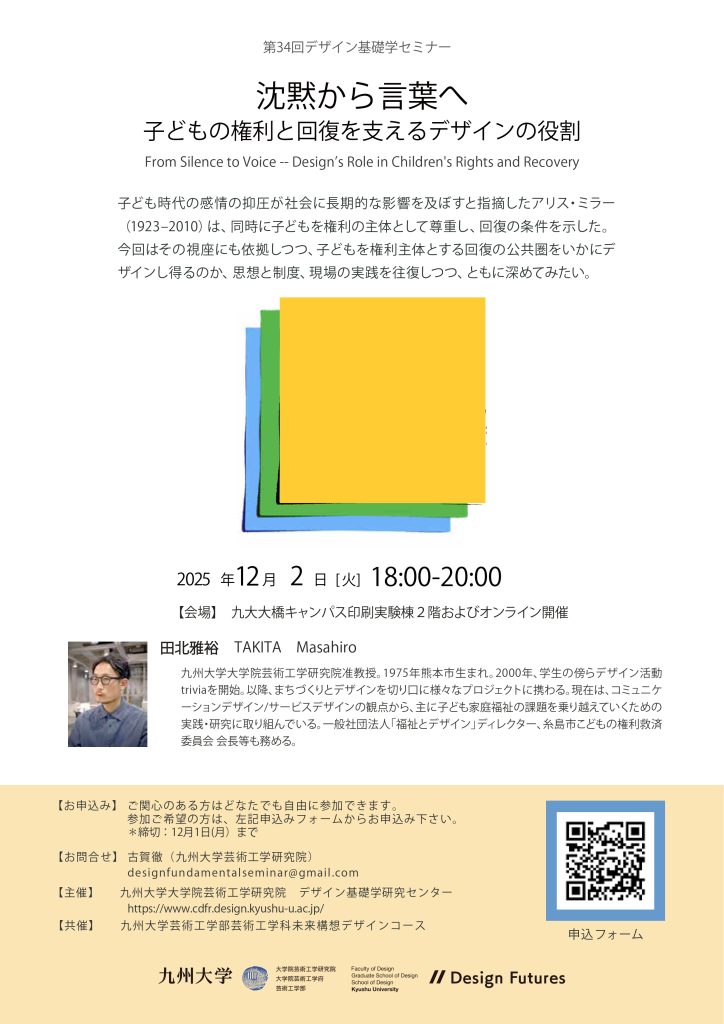
The 34th Design Fundamentals Seminar: From Silence to Voice -- Design’s Role in Children's Rights and Recovery
Alice Miller (1923–2010) pointed out that suppressing childhood emotions has long-term effects on society. She simultaneously respected children as subjects of rights and outlined conditions for recovery. This time, drawing on her perspective, we will explore how we can design a public sphere of recovery that treats children as subjects of rights. Together, we will deepen this discussion, moving back and forth between theory, institutions and practical fieldwork.
Lecturer
TAKITA Masahiro
Born in Kumamoto City in 1975, he began his design activities under the name trivia in 2000 while still a student. Since then, he has been involved in a wide range of community development and design projects. His current research and practice focus on addressing issues in child and family welfare through the perspectives of communication and service design. He also serves as Director of the General Incorporated Association Welfare & Design and as Chairperson of the Itoshima City Children’s Rights Relief Committee.
Date
December 1. 2025 Tue. 18:00~20:00 (Opening from 17:45)
Venue
Printing Laboratory 2F, Kyushu Univ. Ohashi Campus + Online
*All interested parties are free to attend. If you wish to attend, please apply using this application form (lectures will be given in Japanese only).
*If you wish to participate online, the URL and other information will be sent to the address you entered in the form above on the day of the event. Please download the latest version of Zoom in advance.
Host
Center for Design Fundamentals Research, School of Design, Kyushu University
Co-host: Future Design Course, Faculty of Design, Kyushu University
Contact: Professor Toru Koga
designfundamentalseminar#gmail.com(Please replace # with @.)
The 34th Design Fundamentals Seminar(PDF)
Review
Civil wars continue to break out across the world. Relentless, unjustified assaults—large-scale, one-sided, arbitrary acts of physical and psychological violence against defenseless noncombatants who have no means of resisting. Homes and schools become battlefields. What, then, can design do about the hidden violence densely woven into the fabric of our seemingly peaceful everyday lives? This is the challenging question TAKITA Masahiro has taken on.
In Itoshima City, Fukuoka, there is a Children’s Rights Relief Committee, and Takita serves as its chair. The committee has the authority to investigate claims for relief and to make recommendations to the city. However, for legal rights advocacy to be truly effective, it depends on how we cultivate the practical means and social logic that allow rights to function in everyday life.
Rights are not merely guarantees that should exist in law; they come into being through various measures enacted in the intermediate realm of daily social activity. According to Takita, even when the government intervenes to protect abused children—for example, by placing them in temporary protective custody—another situation arises, “ambiguous loss”, coined by Pauline Boss. Children are repeatedly torn away from their familiar homes, relationships, and beloved stuffed animals and toys, pushed into a kind of diaspora in which they are deported from place to place.
What makes these situations a further violation of rights is that rights themselves are fragile; they can only be sustained within a surrounding world of affectionate people and things that continuously care for and support a child. If we call this sustained, emotional connection to people, including relationships with objects and places, “attachment,” then children derive meaning from each attachment, and through the accumulation of these meanings, they build what might be called a “circle of security”—a supportive environment that gives them strength and allows them to gradually venture into the wider world. All forms of social manipulation, pressure, or violence that disrupt this attachment constitute violations of children’s rights.
Alice Miller, whom Takita quoted in his lecture, defines “poisonous pedagogy” as any act that makes reaction impossible. When children are scolded or hit, they naturally respond by crying or protesting. However, educators and parents often treat these reactions as signs of disobedience, and the very emotional reaction becomes the next target of assault. Children deprived of the ability to react become machines that obey adults’ commands without question, emotion, or response. Their repressed emotions are then redirected as aggression toward targets that fall outside social norms. The Führer’s orders, Miller says, ignite these creatures who have had their true selves extinguished.
All reactions are made possible through attachments. The frustration of being humiliated can be expressed through one’s own voice and body, heard and validated by supportive friends and adults, and soothed by familiar toys, stuffed animals, and familiar places. Conversely, when violence forces self-denial and makes one’s own words and body feel alien, the ability to react disappears altogether.
Takita says that directly supporting the recovery of children harmed by abuse is the work of trained specialists and “beyond my capability.” What he can do is help shape environments in which people who have been robbed of words and rendered unable to react can slowly recover themselves through renewed attachment. For example, web interfaces that allow abused children to access public services are critically important, he notes. The “TOKETA Card,” which gently loosens rigid human relationships built on fixed roles, is also his work. He can create footholds—small anchors—to which isolated individuals can begin to attach. He calls this “technology that supplements the space between people.”
The familiar people and things that surround a person form their environment. Perhaps design relates fundamentally to this environment—to the “LANDSCAPE.” This point became the central theme of the lecture and subsequent discussion. Takita recalled the area under a bridge over Kumamoto’s Shirakawa River, where he used to smoke in high school. Today, it is enclosed by fences meant to keep homeless people out. Has modern design, under the banner of improving the environment, destroyed the many forms of attachment that people living there could have turned into their own sources of connection—and in doing so, whitewashed the city? This awareness of the problem embedded in landscape design lies at the heart of Takita’s thinking. If so, then being forced to live in whitewashed cities is itself a violation of rights—an abuse enacted through design. Children, he suggests, are already surrounded by such forms of abuse: the ambiguous deprivation. Preserving the possibility of attachment that pushes back against this abuse—and enriching those possibilities—may be essential to cultivating the rights of all beings, including children.
(KOGA Toru)