
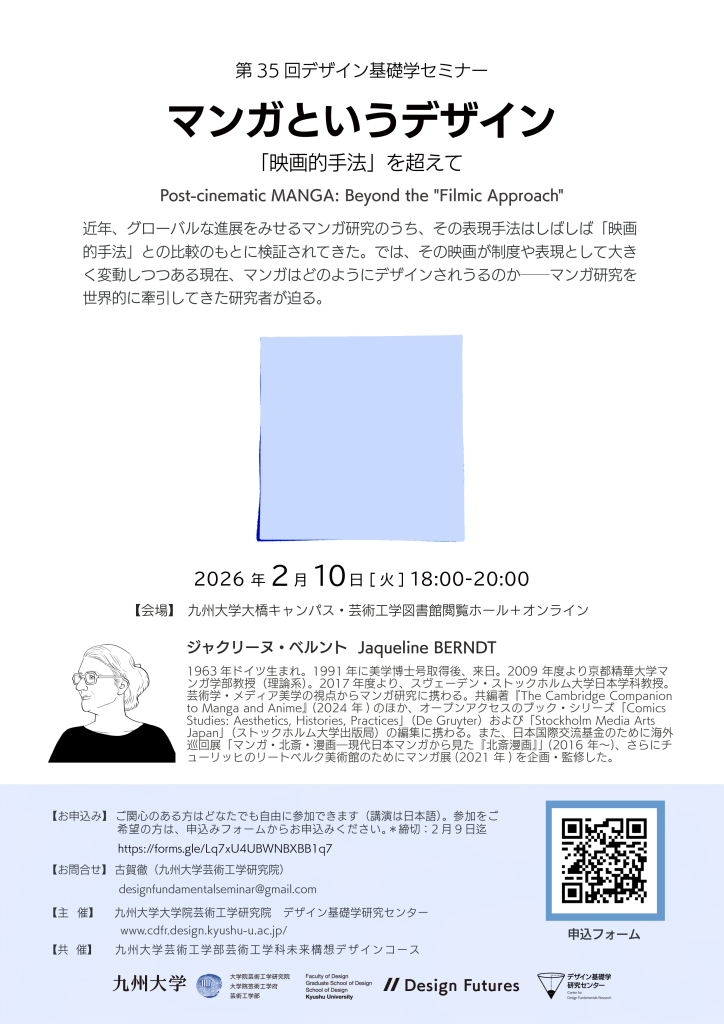
The 35th Design Fundamentals Seminar: Post-cinematic MANGA: Beyond the "Filmic Approach"
Amid recent advancements in manga studies, their expressive techniques have frequently been examined in comparison to the ‘filmic approach’. Yet, as cinema itself undergoes significant shifts in both its institutional framework and modes of expression, the question arises: how might manga be (re)designed? A leading global researcher in manga studies addresses this question.
Lecturer
Jaqueline BERNDT
Jaqueline Berndt holds a first degree in Japanese Studies (1987) and a PhD in Aesthetics/Art Theory from Humboldt University Berlin (1991); she is now Professor in Japanese Culture at Stockholm University. From 1991 to 2016, she worked at Japanese universities, teaching mainly visual culture and media studies in Japanese as well as English; eventually, she served as Professor of Comics Theory at the Graduate School of Manga, Kyoto Seika University. She is managing coeditor of Comics Studies: Aesthetics, Histories, Practices (de Gruyter) and the chairperson of the Open Access book series Stockholm Media Arts Japan (Stockholm University Press). She has also directed exhibitions on manga in art-historical contexts.
Date
Feb.10 2026 Tue. 18:00~20:00 (Opening from 17:45)
Venue
Reading room of Design Library, 1F, Kyushu Univ. Ohashi Campus + Online
*All interested parties are free to attend. If you wish to attend, please apply using this application form (lectures will be given in Japanese).
*If you wish to participate online, the URL and other information will be sent to the address you entered in the form above on the day of the event. Please download the latest version of Zoom in advance.
Host
Center for Design Fundamentals Research, School of Design, Kyushu University
Co-host: Future Design Course, Faculty of Design, Kyushu University
Contact: Professor Toru Koga
designfundamentalseminar#gmail.com(Please replace # with @.)
The 35th Design Fundamentals Seminar(PDF)
Review
Whenever watching documentary TV-programmes like Man-ben, I always find myself holding my breath and staring intently at the scenes where manga artists place their pens on paper or screens and begin drawing manga with such fluidity. What was merely ink stains on a flat surface transform into a multitude of lines that seem to dance rhythmically; by the time these become recognisable as people or objects, they appear to start moving and coming to life. This continuous process of layering the elements that will form part of the “story” eventually creates a narrative world distinct from reality. It is precisely this design mechanism, so simple in its tools yet capable of generating complex and countless variations, that has captivated countless manga artists (and even more readers) for over a century.
The approach to discussing such manga has also undergone significant development in recent years. Until the last century, it was often regarded as lowbrow culture for children, or at best, subjected to simplistic analyses that merely reflected the times, such as drawing parallels between Gekiga and student movements. Recently, however, alongside countless studies of individual authors and narratives, there has been a flourishing of expressive analysis focusing on unique mechanisms such as panels and speech bubbles, as well as comparative research across eras, countries, and media. Whilst discourse on manga has thus diversified, it is also true that the tendency to clarify its media specificity has constantly required other media as points of comparison and reference such as cinema that is indicated by the title of this lecture.
More precisely, it was the filmic approaches that manga, as a narrative medium, had drawn upon, and it was Osamu Tezuka who explicitly articulated this. Indeed, even in the recent large-scale exhibition “Manga. Tout un art!” held at the Guimet Museum in Paris, France, a section was dedicated to “The Creative Power of Osamu Tezuka”, following examples from Ukiyo-e and Kamishibai that preceded this medium, with the phrase “God of Manga” displayed in the room. Although it is undeniable that his work wields considerable influence, Ms. Berndt notes that this is nonetheless somewhat perplexing. For despite Tezuka’s works never having played a major role in the global dissemination of Japanese manga, a literal myth regarding him as a god is spreading abroad.
Thus, a “Shōnen = boy manga-centric perspective”—where the narrative unfolds from a group of authors centred on Tezuka towards the magazine like Shōnen Jump—tends to dominate the historical account of manga. However much discourse on manga may diversify, it seems a linear narrative has always been required for its historicisation. Beyond this, what becomes apparent in the background is not only the image of the “author” who left an overwhelming body of work, but also a desire to borrow an “artistic” status and prestige from existing media such as cinema and fine art. Whether conscious or unconscious, such a historical perspective itself remains a fixed notion within manga studies to this day, Ms. Berndt emphasised from the outset.
However, this is not a problem confined solely to institutional contexts such as exporting or exhibiting manga. Indeed, the bulk of Ms. Berndt’s lecture was devoted to gathering expressions and designs that ‘subvert’ such filmic approach from numerous examples, including Tezuka’s works, to dismantle the dominant historical perspective from within, so to speak.
Essentially, the “filmic approach” refer to a convention in manga expression achieved by treating the panels/frames on the page as film frames and setting the reader’s viewpoint as a “virtual camera”. From this, a close-up on a character can heighten tension, or switching to what the character is looking at in the subsequent panel can smoothly connect the reader’s gaze. In the latter case, the relationship of looking/being looked at often constructs, much like a film’s reverse shot, the politics of gazes between subject and object, frequently between male and female. In this way, continuity editing as defined in film studies has been successfully transplanted onto the manga, efficiently facilitating the reader/audience’s emotional identification with the protagonist.
However, what Ms. Berndt pointed out in her lecture were the numbers of characteristics that, while also originating from Tezuka’s manga expression, tend to interrupt this very continuity (or the proximity of manga and film as media) that enables such narrative.
For instance, anyone who has read Tezuka manga will surely be familiar with the “Hyoutan Tsugi”—a character who appears suddenly and without any context whatsoever to the narrative progression. Alongside his character’s stylised design, Tezuka himself frequently appears within the stories, interacting with the characters or explaining the plot and background. Such intrusions and intermingling of non-diegetic elements are scarcely permitted in film. In contrast, within manga, characters could directly address the reader (in the case of film, the camera/audience) from the supposedly enclosed diegetic space. Furthermore, when characters are startled, they can freely transform into physically implausible forms, much like in cartoons. A prime example of this is when a character’s proportions are suddenly and excessively distorted or small, yet they are still treated as the same character, with no disruption to the narrative flow. These characteristics, which can never be equated with filmic techniques, seem original features of Manga which encourage an emotional investment in the story world while simultaneously maintaining a somewhat distanced or detached perspective from the work itself.
Such depictions that disrupt the diegesis and its continuity are by no means confined to Tezuka’s works or a series of Shōnen manga. For instance, the depiction of enormous eyes frequently appearing in Keiko Takemiya’s works and subsequent Shōjo manga, or the partial disappearance of facial features representing the opposite extreme, could potentially block or disrupt the rigid dynamic of looking/being looked at, previously noted as a physical exchange of gazes. Beyond this, recent examples such as Jyūhan Syuttai (by Matsuda Naoko) frequently feature handwritten text resembling “scribbles,” which often occupy an indeterminate position, leaving unclear whether they constitute dialogue within the narrative world or explanations from external narration. Within Kono Fumiyo’s work, such handwritten text becomes blurred within the arrangement of panels, laid out like textiles, taking on a form that is neither onomatopoeia nor sound effects to express the tension of the scene in a visual and sculptural manner.
The examples thus far essentially constitute numerous characteristics that deviate from filmic approaches, and this is precisely what Ms. Berndt calls “post-cinematic manga”. Post-cinema is often a term referring to the situation where the traditional film system is undergoing transformation alongside shifts in media technology, particularly digitalisation, giving rise to unique forms of spectatorship and expressions. For Ms. Berndt, however, it also presents an opportunity to re-examine the history of manga expression and design. Indeed, the “post” in this context signifies not a temporal “after”, but rather a “detachment” or “moving away” from our fixed notions. As demonstrated by the discussion thus far, her talk, always taking the manga page as its starting point, lightly traversed not only exhibition methods and media technology, but also national borders and eras.
Indeed, the subsequent Q&A saw lively discussions with the audience covering analytical approaches to webtoons and similar formats emerging with recent media technology, historical comparisons with wartime propaganda photo magazines and pre-modern picture books/yellow-cover books (Ezōshi/Kibyōshi), and connections to relevant literary and art theory. What was embodied here seemed to be a heterogeneous nature of Manga, seemingly flowing eloquently from the pen while voraciously absorbing related elements and deviating from linear historical consciousness. In a word, it is the very potential of manga as a design. (Nobuhiro MASUDA)